
CRITICAL ANGLE (Continued)
OPENING QUESTIONS:
-
A light ray is incident up from water (n = 1.33) into air at an angle of 42.0 degrees. Sketch that situation and label each medium and the index of refraction for each medium.
-
Without doing any calculations (yet!), predict whether the light ray will bend towards the normal line, away from the normal line or will continue directly through air with any bending at all.
-
Now do the math. Does it work? Does it blow up?
-
Revise your part 3 response as needed
═══════════════════════════
LEARNING TARGET: I will be able to describe 'critical angle' to an articulate 12 year after today's class.
CALENDAR:
Light Unit Test on Thursday
FORMULAE OBJECTUS:
θi = θr Angle of incidence = angle of reflection
c/v = n Index of refraction
Snell's Law: n1sin Θ1= n2sinΘ2
LEARNING TARGET: I will be able to calculate the critical angle for an incident light ray during today's class.
WORDS O' THE DAY:
- medium (material through which light is traveling)
- Reflection ("Light waves bouncing off an object")
- Emission ("Light is given off by an object")
- Absorption ("Some wavelengths of light are absorbed by an object")
- Refraction ("Light bending as it changes medium")
- Angle of Incidence ("The angle a light ray takes as it moves toward a reflecting surface")
- Angle of Reflection ("The angle a light ray takes as it moves away from a reflecting object")
- Retroreflection ("incident light waves are 'double bounced' back to the observer, regardless of the angle of incidence")
- Critical Angle: ("The angle {θc} where light is TOTALLY internally reflected")
WORK O' THE DAY:
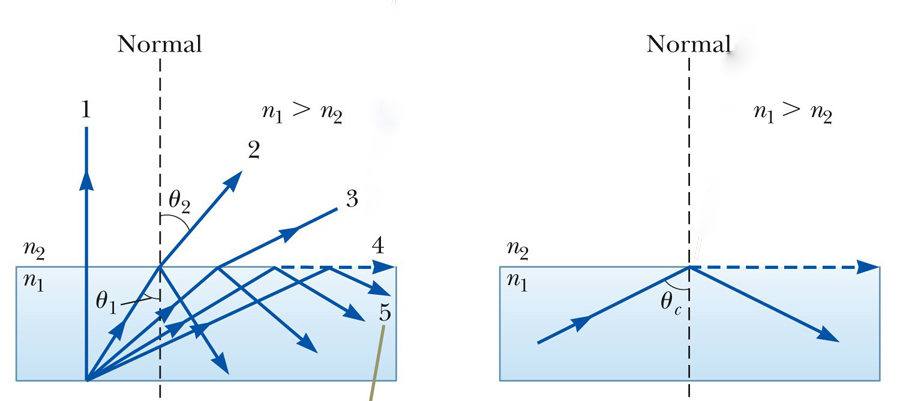
The critical angle for diamond is 24 degrees
The index of refraction for diamond is 2.42
Use your knowledge of Snell's Law in general and critical angles in particular to derive a method for calculating the critical angle in general.
Will it work for all substances?
(Answer On Tomorrow's Plan)
Now please work with your group to design your own index of refraction problem.
Let's get those on the board
═══════════════════════════